

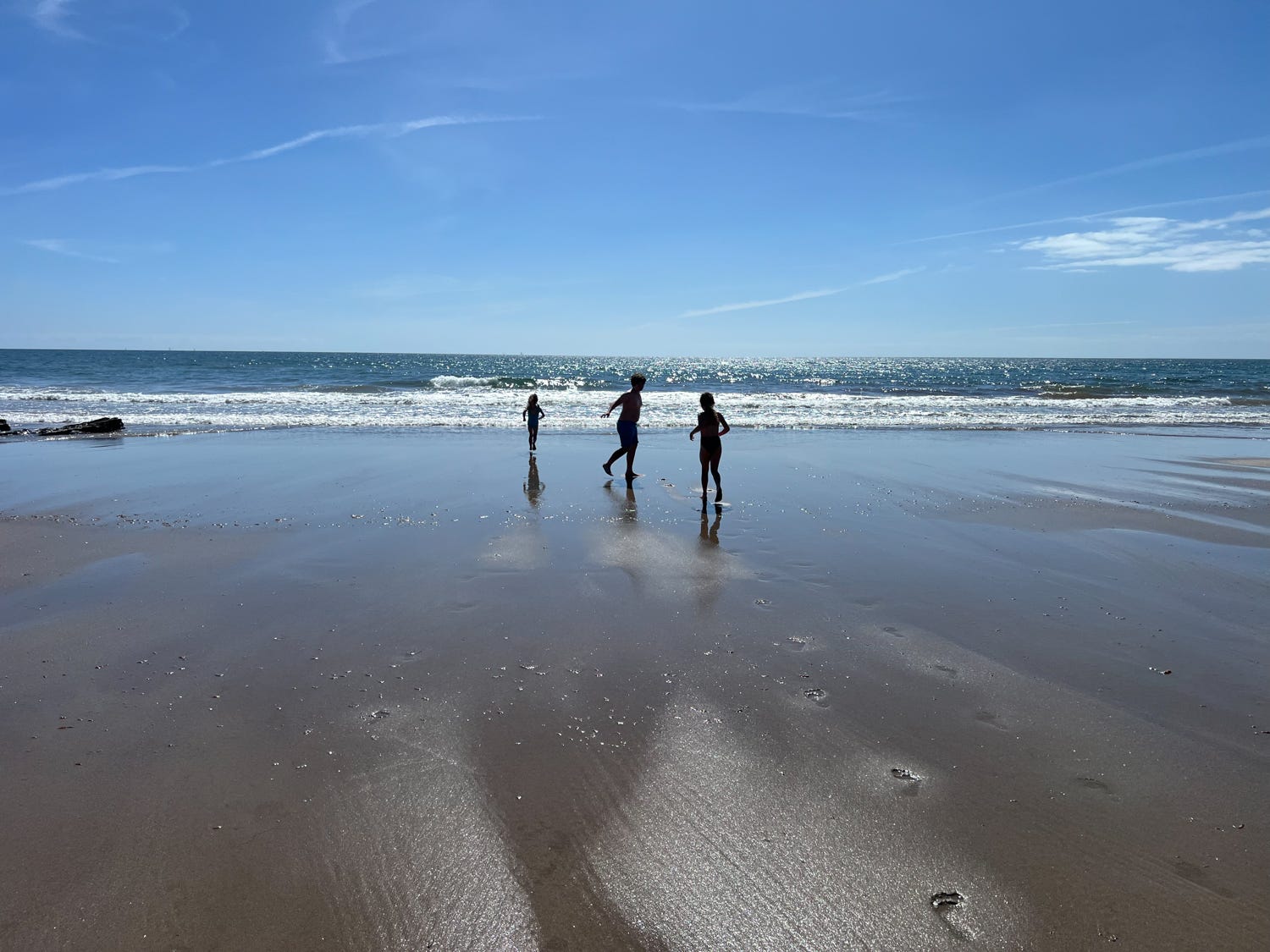
My wife and I shelter from the wind behind a rock but the children, oblivious to the subtle charms of a Cornish summer, don’t notice.
Below us on the sand, they’re deep in debate.
"You can't change the rules halfway through!" my second son protests, indignantly.
"We're not changing them, we're improving them."
My daughter argues her case with lawyer-like precision. But the boys are older and often pull rank. She doesn’t always ‘win’, even when she’s right.
“Look - if you get tagged whilst carrying the shell, you have to do three jumping jacks before you can rejoin your team. That's fair.”
They’re reinventing that old playground classic, ‘Stuck in the mud’, and so far they’ve spent more time negotiating than actually playing.
"But what if you're already in a safe zone when you get the shell?"
"Then you get three seconds to decide - stay safe or make a run for it."
The debate continues for twenty minutes. Complex negotiations unfold about boundary lines, team switching, and what constitutes a fair tag.
I check the time. We have to go.
But the game hasn’t got going yet. Can I really spoil the fun? So much good learning is taking place. Away from the pressures of home, with confined spaces and hours spent in the car on the school run, the boys are letting go of their need to dominate. They listen to the girls. They relax. And a deeper, richer world of play opens up.
If we wait any longer, the fish and chip van will be closed and we’ll be eating supermarket pizza - again.
But this is an opportunity I won’t miss.
Playtime, interrupted
Do you remember your school days? Those endless lunch breaks when the play seemed to go on for hours.
But the lesson bell always came.
“Oh! We were just getting started!”
“You can carry on tomorrow,” the teacher on duty would say. But we all knew the moment had passed.
Your carefully constructed game dissolved as you lined up for class, your elaborate social experiment abandoned.
And so the playground empties, leaving behind only the ghost of something that was once the most important work of childhood - learning to be human through play.
Childhood can’t do its job
Here’s what we rarely admit: we have dismantled childhood, piece by piece. Not through neglect or cruelty, but through love and good intentions - our drive to optimise, protect, and enrich every waking moment.
Evolutionary psychologist Peter Gray puts it bluntly: “Children are designed, by nature, to play and explore on their own, independently of adults. They need freedom in order to develop; without it they suffer.”
Yet somewhere along the way, we decided that childhood was too important to leave to children. We scheduled it, supervised it, structured it - and in the process, we may have weakened the very foundation on which capable adulthood is built.
Play is a biological drive
The drive to play freely is a basic, biological drive. Lack of free play may not kill the physical body, as would lack of food, air, or water, but it kills the spirit and stunts mental growth.
Peter Gray
Studies comparing children’s freedom across decades show that the “roaming radius” - how far children can travel from home unsupervised - has shrunk by 90% since the 1970s.
We’ve created the safest generation of children in history. Yet childhood anxiety and depression rates have soared.
Children who experience primarily adult-directed activities show:
Reduced executive function - they're less able to set and achieve goals independently
Increased anxiety - they haven't learned to navigate uncertainty and conflict
Diminished creativity - they wait for instructions rather than generating solutions
Poor risk assessment - they either take dangerous risks or become paralysed by minor challenges
Meanwhile, children who have regular access to free play develop:
Self-regulation - the ability to manage emotions and behaviour without external control
Social competence - skill at reading social cues and negotiating relationships
Resilience - experience bouncing back from failure and disappointment
Intrinsic motivation - the capacity to engage deeply with activities they find meaningful
The price of protection
When I turned ten, I was allowed to make short journeys on my own. I walked to school, taking my younger sister with me. I played tennis with my friends. I had pocket money for sweets: Flying Saucers, Black Jacks and Drumsticks.
Those were good times.
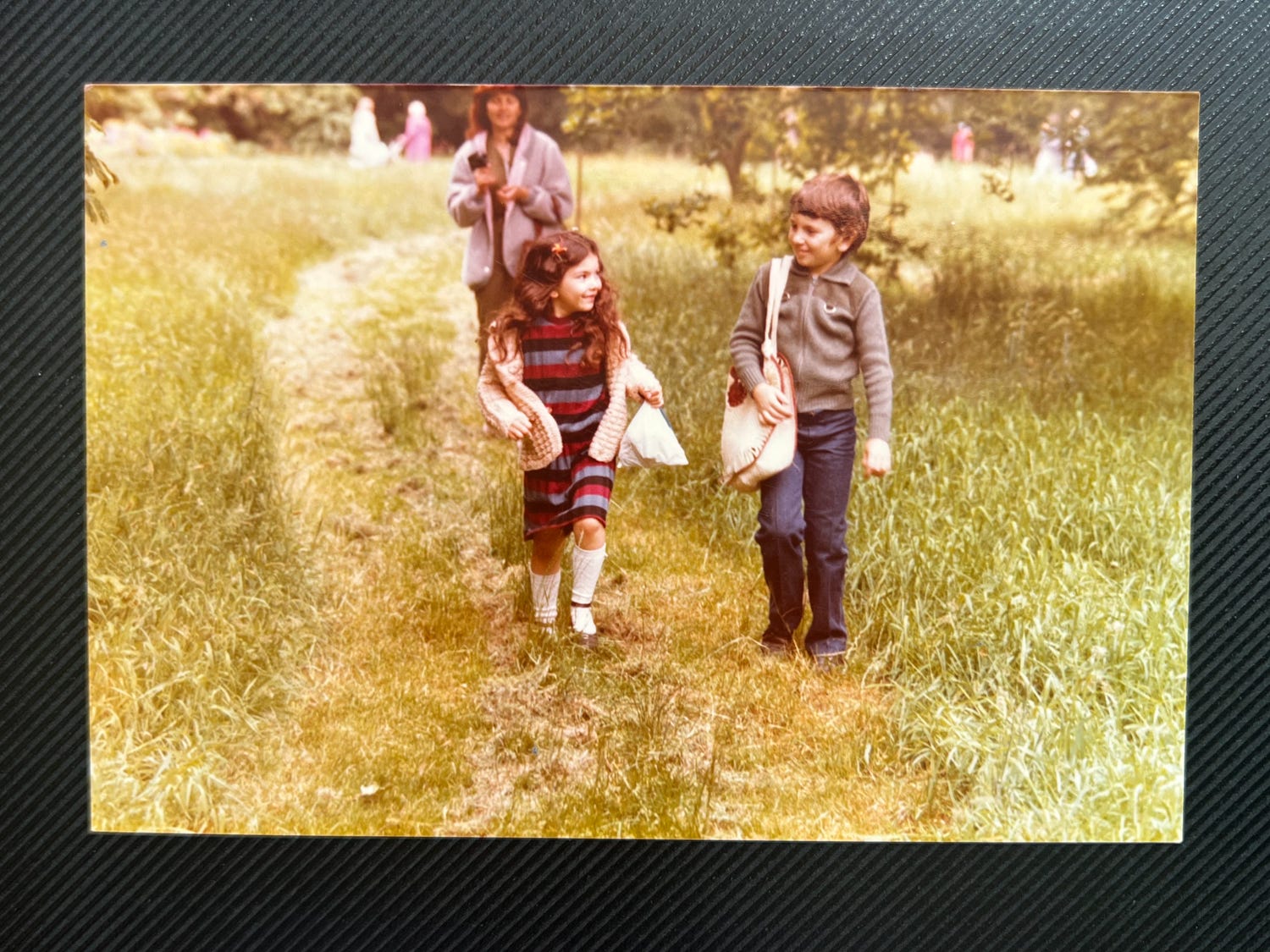
Best of all, I was allowed to stop at the park after school.
Can you imagine my excitement the first time we had deep snow?
We threw snowballs for hours and, before we knew it, the sun was setting. Time for home.
My friends went one way; I went the other.
The pond had frozen over and there were a few brave children standing tentatively around its perimeter - close enough to leap for dry land in case of mishap.
Looks pretty solid to me, I thought. I’ll walk across.
Now, of course, my parents had warned me many times not to do anything as stupid as this. But I was ten and I thought I knew better.
Halfway across. So far, so good.
Then I noticed a hole in the ice. Only three or four feet wide.
No problem. I’ll leap over it.
Easy for a big boy like me. And in one great bound I was on the other side.
But ice around a hole is paper thin.
With an awful, terrifying crack, I was through it and into the water. Worse, my forward motion was taking me under the ice rather than straight down. I was going to find myself several feet past the opening, trapped under an impenetrable shelf.
My feet slid under, then my legs. It happened in the blink of an eye. Before I could think, my whole body was submerged, the ice pushing me down.
Is this the end for Rocky and Bullwinkle?
(I’ve always wanted to write a cliff-hanger, but you rarely get the chance with Early Years blogs…)
Just as my chin entered the water, my arm caught the edge and I was saved.
Hasta luego, Grim Reaper.
Davy Jones’ locker can wait.
The walk home in the dark was excruciating. I’ve never been so cold.
And I bet you can imagine my mum’s face when she opened the door…
Grounded?
To my parents’ eternal credit, I wasn’t grounded.
I’d learnt my lesson and the next day I was back out in the snow.
It must have been tempting to keep me home, to keep me safe.
But that ‘safety’ is paradoxical: the more we try to protect our children, the more vulnerable they become. When we remove risk and problems and conflict, we deny them the chance to develop the tools to resolve these difficulties by themselves.
Gray argues that "nothing that we do, no amount of toys we buy or 'quality time' or special training we give our children, can compensate for the freedom we take away. The things that children learn through their own initiatives, in free play, cannot be taught in other ways."
We’ve forgotten what made our own childhood so special - and the skills it gave us to develop into capable adults.
What did your childhood teach you?
Think back to your own early years. What do you remember most vividly - the structured activities your parents arranged, or the adventures you invented with other children when adults weren’t watching?
I’m all in favour of piano lessons and after-school gymnastics. But break them open and you won’t find ‘childhood’ inside.
No, the real magic happened when you vanished for hours, wrestling with social problems without adult referees, taking the physical and emotional risks that come with true independence.
Can you imagine granting your child that kind of freedom today?
How parents make space for unsupervised play
If unsupervised play is so vital, how can you give your child more of it - in a world that seems designed to eliminate it? Here are some simple starting points:
Create pockets of time. Protect at least a few unstructured hours each week where there’s no scheduled activity, no agenda, and no hovering adult.
Widen the boundaries. If roaming the neighbourhood isn’t possible, expand freedom within safe limits: the garden, the local park, or even a corner of the house you deliberately leave “adult-free.”
Resist the urge to step in. Arguments, squabbles, and negotiations are the curriculum of unsupervised play. Unless safety is at risk, hold back.
Value boredom. When children complain they have nothing to do, see it as the threshold of creativity rather than a problem to fix.
Model trust. Tell your child explicitly: “I trust you to work it out.” Those words give her confidence and permission to take ownership.
Reclaiming freedom
My second son is walking home from school today for the first time.
It’s a mix of nerves and excitement - for both of us.
Like the heroes of my favourite book as child, Bears in the Night, he has to go: down the hill, under the road, across the bridge, around the lake, through the streets, into the door - and back to bed (OK, not into bed. Those bears were out past their bedtime).
There’s no spooky owl to send him scampering - though there are all kinds of other dangers on a London street. But I can’t protect him forever. As Alison Gopnik says, in The Gardener and the Carpenter:
Part of the pathos, but also the moral depth, of being a parent is that a good parent creates an adult who can make his own choices, even disastrous choices. A secure, stable childhood allows children to explore, to try entirely new ways of living and being, to take risks. And risks aren’t risks unless they can come out badly. If there isn’t some chance that our children will fail as adults, then we haven’t succeeded as parents.
He’s ready.
It’s time.
(But, I have to admit, I’m glad it’s September so the pond won’t be frozen over!)